Launch Ceremony of the Brand Identity System and Strategic Cooperation Signing with Partner Organizations
After a comprehensive process of research, design, refinement, and standardization, Hanoi Metropolitan University officially unveiled its new brand identity system, featuring a modern and synchronized set of branding standards.
The brand identity system includes key elements such as the standard logo, primary color palette, typography, size regulations, safe spacing guidelines, and applications across various products and publications.

Associate Professor Dr. Do Hong Cuong, President of the University, and Dr. Tran Anh Tuan, Vice President, perform the official launch ceremony of Hanoi Metropolitan University’s brand identity system.
The development of this brand identity aims to ensure consistency in communication while reinforcing the University’s distinctive identity within the higher education system.
A prominent highlight of the new identity lies in its meaningful symbolic design. The outer geometric structure in deep blue is stylized from the letter “U” — the first letter of “University” — associated with the institution’s name and founding year (1959). Above it, soft lines evoke the image of a bird soaring upward or an open book, symbolizing knowledge and the endless journey of learning. When inverted, the symbol resembles a mountain peak, representing aspiration, growth, and the pursuit of new heights.
In addition, the image of Khue Van Cac — an iconic cultural symbol of Hanoi — is integrated into the design, reflecting the inheritance of the capital’s scholarly tradition and reverence for knowledge. The harmonious combination of traditional and modern elements not only creates a unique visual identity but also conveys the University’s vision and aspirations for sustainable development in the new era.
The brand identity system will be consistently applied across multiple areas of the University’s operations, including administrative systems, education, scientific research, signage, uniforms, communication materials, and gifts. This unified implementation is expected to enhance professionalism, strengthen brand recognition, and elevate Hanoi Metropolitan University’s reputation within the community.
Speaking at the ceremony, Associate Professor Dr. Do Hong Cuong emphasized that the brand identity is not merely a visual element but also embodies profound messages about the University’s vision, core values, and spirit of innovation. It represents an important step toward standardizing the institution’s image, unifying communication activities, and affirming its determination to enhance its standing within Vietnam’s higher education system.
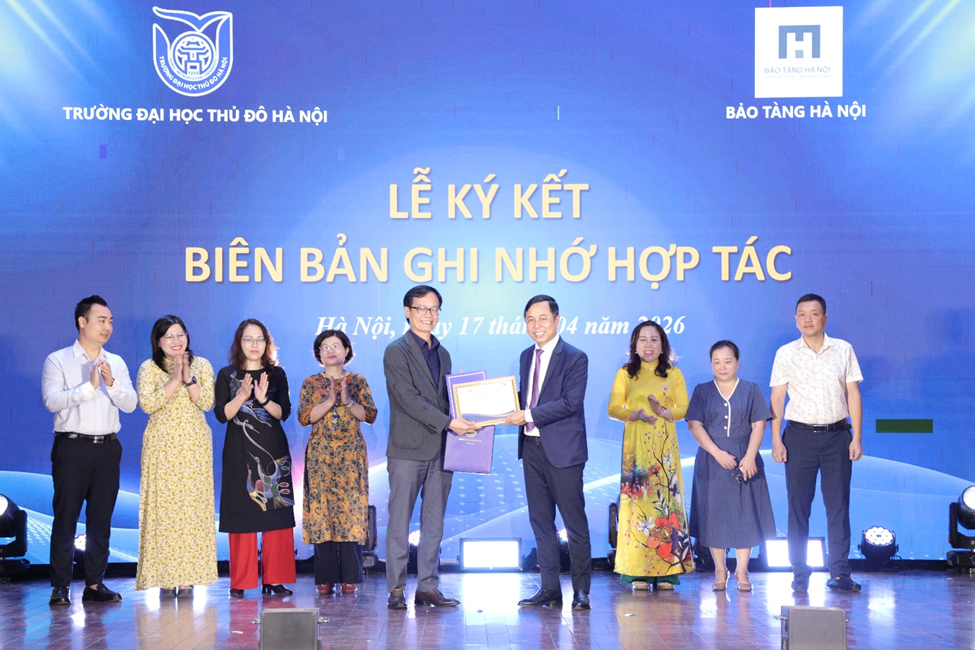
Associate Professor Dr. Do Hong Cuong, President of the University, together with representatives of partner organizations at the memorandum signing ceremony.
As part of the program, the University also signed cooperation agreements with partners both within and beyond the education sector. These activities aim to expand collaborative networks, strengthen educational and scientific research partnerships, and create more learning and practical opportunities for students. The agreements are expected to contribute to improving educational quality while fostering stronger connections between the University, businesses, and society.
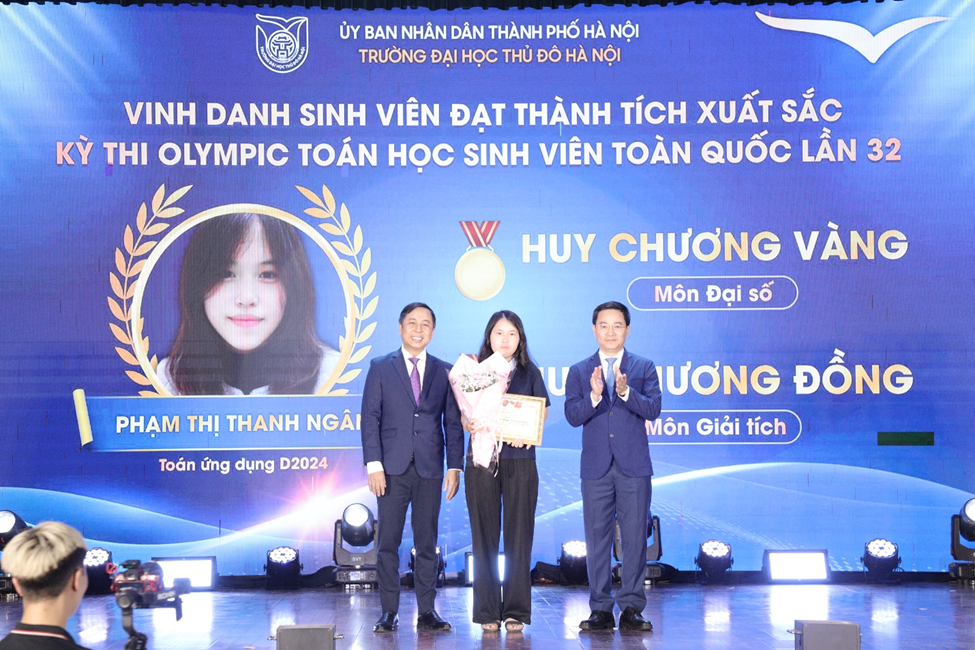
Associate Professor Dr. Do Hong Cuong, President of the University, and Dr. Tran Anh Tuan, Vice President, honor students for their achievements in the Mathematical Olympiad.
During the event, Hanoi Metropolitan University also presented awards to students who achieved outstanding success in the National Mathematical Olympiad. This served as an opportunity to recognize students’ academic dedication, research efforts, and creativity while encouraging the growth of academic excellence throughout the University.
The simultaneous implementation of these important initiatives demonstrates Hanoi Metropolitan University’s comprehensive development orientation — focusing not only on strengthening its image and brand but also on expanding cooperation, improving educational quality, and aligning more closely with societal needs.